Prehistory and Early History (11000 BCE – 200 BCE)
The continent of Thusald, positioned in the mid-north Atlantic, was settled in three broad demographic waves across roughly nine millennia. Each wave introduced a genetically, culturally, and linguistically distinct population. The Baraka culture, which originated in North Africa and was descended from Iberomaurusian peoples, began settling the continent via its western coasts and island chains between 11000 BCE and 9000 BCE. With the end of the Ice Age, the Barakans would be isolated from the African continent, further encouraging eastward migration. Recent archaeological studies have also revealed possible genetic contributions from Paleolithic Iberia among the Barakans, with most Barakan samples deriving 10-25% of their admixture from Iberian populations. The Lyndger culture arrived from northeastern North America around 1000 BCE, and established themselves in the cooler northeastern reaches of Thusald. Finally, the Caniban peoples of South America arrived between 2000 BCE and 0 CE, settling the southern archipelagos of Thusald as the Ocotan culture. They were believed to be close relatives of other ethnolinguistic groups of the Amazon, but no conclusive links have been drawn between their now-extinct language and those of modern-day South America.
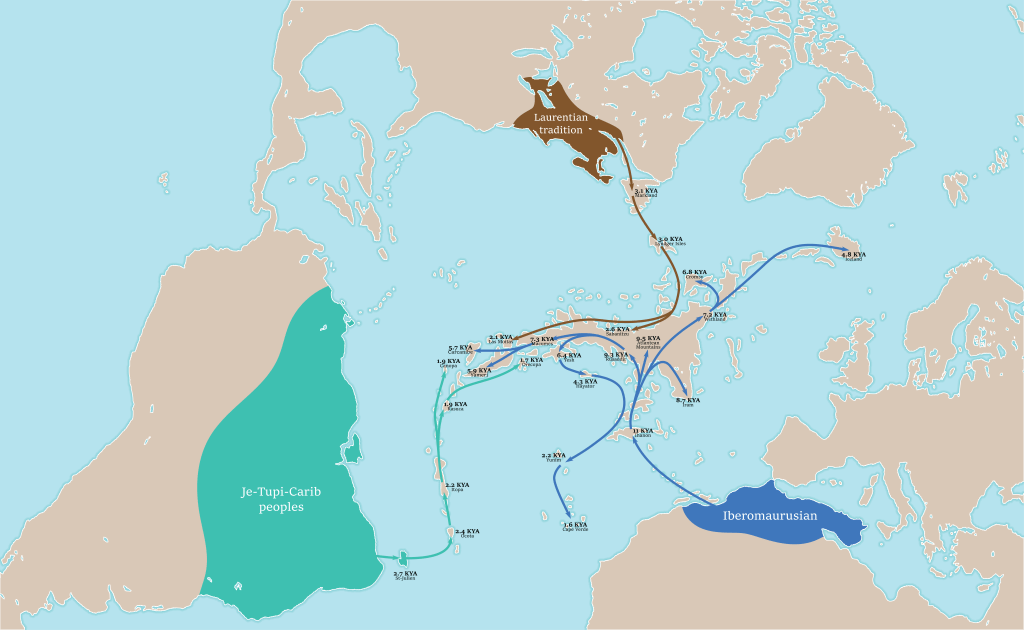
Map of human migration within Thusald
These three founding populations formed the genetic and cultural substrate of all later Thusaldian civilizations. By the time Old World contact occurred in the 15th century, centuries of intermarriage, cultural diffusion, and political interaction had blurred but not erased the original tripartite character of Thusaldian identity. Understanding the founding peoples is therefore essential to understanding subsequent developments. Below is an explanation of each cultural group, what is known of their origins, and how they contributed to the development of human settlement in Thusald.
Founding Cultures
Baraka
The Baraka culture represents the founding population of the entire continent of Thusald. Their ancestors were North African immigrants who arrived through the Canary Islands, and were originally descendants of the Iberomaurusian culture. This was the predominant cultural group of North Africa in the Late Upper Paleolithic. Genetic samples taken from sites where the Baraka culture left remains reveal that they typically derived most of their ancestry from the Iberomaurusians, but a significant minority from the hunter-gatherer populations of Paleolithic Iberia.
The early members of this group were nomads who were adept at crossing large distances over water. While those who ventured south retained this tradition, their cousins in northern Thusald would begin to practice agriculture in 6000 BCE. Proto-villages appeared in the lowlands of Azram and northern Launen, clustered around river mouths and resource-rich zones. Like the Iberomaurusians, they also practiced tooth avulsion (the intentional removal of teeth) as a rite of passage, usually targeting the upper central incisors.
Lyndger
The Lyndger culture was the second major founding population of Thusald. They arrived several thousand years after the Barakans, and were descendants of the Laurentian Archaic tradition, a Late Archaic complex that flourished in the St. Lawrence valley and Great Lakes region of northeastern North America from approximately 6000 BCE to 2500 BCE. They were known for their ground stone technology, copper working, and sophisticated fishing economies.
By 1000 BCE, they migrated to Thusald and introduced their technological achievements to the continent. They would soon find prosperity due to the abundance of copper deposits in northwestern Thusald, which also facilitated cultural exchanges with the other inhabitants of the continent. The earliest Lyndgerians were atlatl hunters, using spearthrowers to cast long darts with sharp bone points. As they transitioned to the sedentary lifestyle of their neighbors in Thusald, atlatl weights would become prestigious artifacts that were often polished for display.
Ocotan
The Ocotans were direct descendants of Native Americans who arrived from South America, and were believed to be an early offshoot of the Je-Tupi-Carib cultural complex. They are most known for the spread of the Caniban languages throughout southern Thusald. Despite their origins, the Caniban language family is not believed to be related to the Je-Tupi-Carib languages. It constitutes an isolate of its own that shares a few Wanderworts (words that have spread as loanwords among numerous languages that might not necessarily be related), and nothing more.
Unlike the Barakans (who practiced tooth avulsions) and the Lyndgerians, the Ocotans practiced extensive body modification. Common forms of modification included:
- Large disc-shaped inserts in the lower lip and/or cheeks, which were also typical of Tupian cultures in South America. Differing sizes and materials could distinguish individuals based on age, status, and group affiliation.
- Ear ornaments that modified and distended ear lobes.
- Extensive use of red-orange body paint fashioned from the achiote tree (B. orellana), which grows natively in the tropical island chains of Thusald. Specific paint patterns and color schemes carried great cultural significance.
The Ocotans were the only founding population of Thusald to arrive with a pre-existing agricultural foundation. This immediately gave them a demographic advantage, and allowed their influence to extend far beyond the areas they settled. They introduced the cultivation of cassava, maize, sweet potato, peanuts, and tobacco to neighboring peoples.
Bronze Age (1000 BCE – 500 BCE)
Text.
Iron Age (500 BCE – 200 BCE)
Text.
Classical Era (200 BCE – 500 CE)
Text.
Middle Ages (500 CE – 1492 CE)
Text.
Early Modern Period (1492 CE – 1815 CE)
Text.
Modern Period (1815 CE – Present)
Text.
 Raymond Puentes